Pendidikan Akidah Pada Santri Kuttab Al-Firdaus Kota Lhokseumawe
DOI:
https://doi.org/10.22373/tadabbur.v3i1.149Keywords:
Education;, Aqeedah;, Kuttab;Abstract
The responsibility of religious education is the most important responsibility for parents and educators because it is the center of all resources. However, in practice there are still many educators who do not pay attention to the religious education of their students, they prioritize education that is only worldly. The research method used is qualitative research. Data collected through observation, interviews, and documentation. The data analysis technique used is thematic analysis. The results of this study indicate that the implementation of Islamic education in Kuttab students is going well. Opportunities for the application of Islamic education to Kuttab students starting from the education system, curriculum, and teachers are extraordinary in maximizing education for children. However, it also has challenges that greatly affect children's education, namely gadgets, games, and shows that are not beneficial to children, so it greatly influences the education of their faith. The advantages of the implementation of Islamic education in Kuttab, namely that children have begun to form creeds according to their age. While the drawbacks are that the application and understanding of Islamic education in Kuttab are not comprehensive and agree on all teachers and the environment that does not support the concepts that have been implanted in Kuttab.
References
Abdullah Nashih Ulwan.Pendidikan Anak dalam Islam. Cet. III, Jakarta: Pustaka Amani, 2002.
Azmi, and Bayu Suratman. ΓÇ£Problematika Pembelajaran Alquran Di Kalangan Masyarakat Melayu Sambas, Indonesia (Analisis Kontrastif Titik Batas Fonem Bahasa Arab Dan Melayu Sambas).ΓÇ¥ DAYAH: Journal of Islamic Education 3, no. 2 (July 27, 2020): 230. https://doi.org/10.22373/jie.v3i2.7119.
Abdurrahman An-Nahlawi. Pendidikan Islam di Rumah dan Masyaraka. Jakarta: Gema Insani Press, 1995.
Beyatzis (1998), https://wiwinhendriani.com/2012/12/17/dua-langkah-analisis-tematik-boyatzis-1998/senin, (diakses, Senin 16 juli 2018).
Imam Abu Husain Muslim bin Hajjaj al Qusyairi, Shahih Muslim, Juz IV, Terjm. Adib Bisri Musthofa, Semarang: Asy -Syifa, 1993.
Maimun, Achmad, and Achmad Maimun. ΓÇ£Studi Kritis Terhadap Buku Siswa Mata Pelajaran Pendidikan Agama Islam Dan Budi Pekerti.ΓÇ¥ DAYAH: Journal of Islamic Education 3, no. 2 (July 27, 2020): 194. https://doi.org/10.22373/jie.v3i2.7185.
Makhtum, Miskul. ΓÇ£Pendekatan Kontekstual Dalam Meningkatkan Pemahaman Konsep Aqidah Di MAN Kelas X MAN Model Banda Aceh.ΓÇ¥ DAYAH: Journal of Islamic Education, 2019. https://doi.org/10.22373/jie.v2i1.4168.
Nana Syaodih Sukmadinata. Metode Penelitian Pendidikan. Bandung: Remaja Rosdakarya, 2008.
Sukmadinata.Metodologi Penelitian Pendidikan. Bandung: Remaja Rosdakarya, 2005.

Downloads
Published
Issue
Section
License
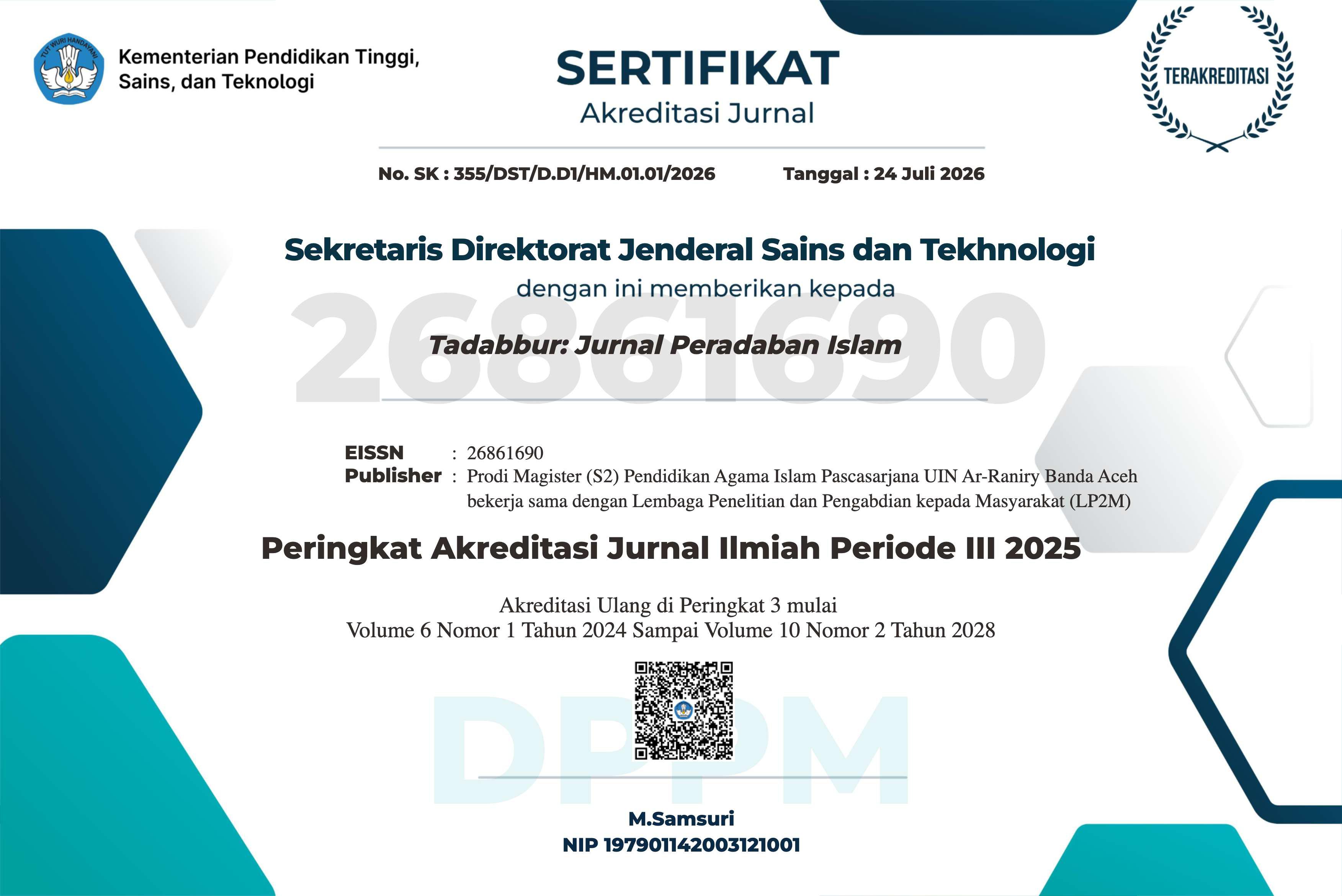
Authors who publish with Tadabbur: Jurnal Peradaban Islam agree to the following terms:
-
Authors retain copyright and grant the journal right of first publication with the work simultaneously licensed under a Creative Commons Attribution-ShareAlike 4.0 International License (CC BY-SA 4.0) that allows others to share (copy and redistribute the material in any medium or format) and adapt (remix, transform, and build upon the material for any purpose, even commercially) the work with an acknowledgement of the work's authorship and initial publication in this journal.
-
Authors are able to enter into separate, additional contractual arrangements for the non-exclusive distribution of the journal's published version of the work (e.g., post it to an institutional repository or publish it in a book), with an acknowledgement of its initial publication in this journal.
-
Authors are permitted and encouraged to post their work online (e.g., in institutional repositories or on their website) prior to and during the submission process, as it can lead to productive exchanges, as well as earlier and greater citation of published work.